STAGFLATION
I would like to present some of my learnings on Stagflation. Any student of economics is aware of what Inflation is and we have seen examples in our own country where there is increasing trend of price rise and protests by people over rising prices. One is aware that inflation is the rate of increase in prices over a given period of time. Interestingly, however, a consistent and persistent inflation is actually called stagflation. One of the most glaring examples of stagflation was in the 1970’s.
The Oil Crisis of 1970
During the 1970’s and early 80’s, countries like the United States found themselves in a peculiar predicament. In the mid-twentieth century and after the World War II, OPEC (Organisation of the Petroleum Exporting Countries) members sought to gain greater control over oil prices worldwide although US was the largest producer and consumer of oil. Members of the OPEC proclaimed an oil embargo against the United States in retaliation to the US support for Israel during the 1973 Arab-Israeli War. As a result, the oil prices had risen from $3 per barrel to nearly 12 $ globally.
Stagflation was long believed to be impossible because until the 1970’s, there actually appeared to be an inverse relationship between unemployment and inflation as represented by the Philips Curve. But the oil crisis of 1973 and the subsequent aftermath broke down the relationship established between unemployment and inflation and sowed the seeds of a new concept in which both the quantities had a precipitous increase. As oil prices shot up, transportation costs also rose. In the oil crisis, as the supply of oil was restricted, the countries faced difficulty in adapting to higher energy costs, economic output plummeted and unemployment rose. This situation is known as a supply shock and occurs when there is a substantial change in the supply of a commodity. The supply shock is the most notable and prominent cause of the problem of stagflation.
What is stagflation?
In simple words, stagflation is a peculiar situation in which there is STAGNANT DEMAND, HIGH UNEMPLOYMENT and HIGH INFLATION. The term ‘stagflation’ was coined by the politician Iain Macleod in 1965 who said in a speech in the parliament, “We now have the worst of both worlds – not just inflation on the one side or stagnation on the other, but both of them together. We have a sort of ‘stagflation’ situation”. Stagflation has both short-term and long-term consequences.
The next step, therefore, is to see how stagflation can be cured or brought under control. Although it does not seem easy, yet there are few methods suggested by economists in curbing stagflation. The first would be to reduce the fiscal deficit of the government. Secondly, if stagflation is mainly due to supply shock, then the solution would be to reduce the money supply by increasing interest rates and quantitative tightening (QT).
Another interesting case study would be that of Brazil. Brazil is the largest economy in South America and the eighth largest in the world. Yet, it is an economy with a history of high inflation. According to the International Monetary Fund, its growth rate declined from 7.5% in 2010 to -3.25% in 2015. Its unemployment also saw a spike from 6.92% in 2011 to 12.82% in 2017. These data evince the existence of stagflation in Brazil.
Closer home due to the current covid impact on economy, the country is witnessing high levels of inflation as measured by WPI (Wholesale Price Inflation) of 14% and low economic growth of 6%. This is impacting employment and there are serious job losses associated with stagflationary environment. The key for governments is to stay ahead of the curve and avoid stagflation at all costs as the human costs associated with stagflation are way too high.
COVID – 19 – ECONOMIC IMPACT ON SOCIETY
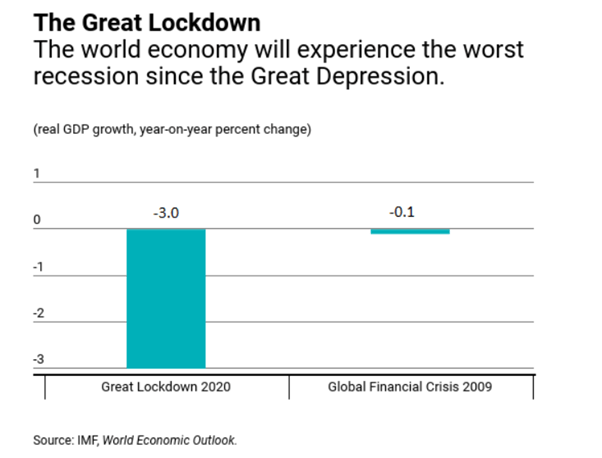
“The cumulative loss to global GDP over 2020 and 2021 from the pandemic crisis could be around 9 trillion dollars, greater than the economies of Japan and Germany, combined.” remarks the International Monetary Fund (IMF). The COVID-19 pandemic has probably given the biggest blow to the world economy after the great depression of 1930s. This short essay will describe the various economic impacts to society due to Covid-19.
Covid pandemic has affected the lives of millions of people throughout the world. The economic impact of this Great Lockdown, the worst recession since the Great Depression, is so legion that enumerating them would prove to be a tough row to hoe.
Following are some of the crucial impacts and ramifications of the pandemic on the Indian economy and its people.
- Firstly, the supply chain management in the FMCG sector, the fourth largest sector of the Indian economy, is disrupted significantly. This has resulted in many FMCG firms unable to ship products to end consumers. The demand for some products spiked and some dropped. Doubling capacity from the suppliers was not possible overnight as the FMCG giants ran a tight and efficient chain. This resulted in significant delays to product shipments and spike in product prices which were in demand.
- The second impact is on inflation experienced by the poor and middle class. As food inflation spiked due to supply chain disruptions caused by the lockdown, Sharma, 43-year-old, who drives an autorickshaw in New Delhi, said that all his hope has turned into gloom.
- As hospitals started to overflow and there was need to make payments to near and dear ones, there was a dent on household savings as they had to pledge/sell their assets to take care of their loved ones.
- The COVID-19 pandemic has exposed all the existing cracks in our society, one of the most crucial being the acute food insecurity faced by a large portion of the population. Although food insecurity was prevalent in India even before the pandemic, the trend, however, was exacerbated as India went into lockdown among India’s penurious and migrant populations, whose lives gradually became even more dubious. “Since the onset of the pandemic, one out of every three children below the age of five years, is suffering from chronic undernourishment.”, states The National Family Health Survey(NFHS 5).
- Demand destruction was visible in the auto shipments and petrol/diesel sales. This impacted the overall GDP of the economy.
- Since schools and colleges were closed, the livelihood of maids, school bus drivers, support staff got a hit because of layoffs.
- The hotels, restaurants and aviation industry took a big hit as people postponed their travel plans. The chart below shows the negative impact
Even though there were many negative impacts on society, there is a silver lining in all of this as well. These include:
- The pharmaceutical sector has seen a rise in the Covid-19 pandemic, with a spike in the consumption of generic drugs globally.
- The lasting impact would be on awareness on cleanliness and need to maintain personal hygiene.
- Since many impacted families include people who did not maintain proper exercise and weight, the covid pandemic has exposed the need to maintain good health going forward.
As a saying goes, “Never let a crisis or an opportunity go waste”, it is imperative for the society to ponder over the vulnerability of the poor and middle class, the marginalized and work on remedial actions which will help in better lives of all sections of the society.
INTERNET – A NECESSARY EVIL?
A famous adage of Bill Gates goes like this – “The Internet is becoming the town square of the global village of tomorrow.” This quote has been proved right by the current developments in Technology. The use of Internet has heralded a significant revolution in the global world. It has indeed shrunk the globe and brought people together. From a 3-year-old child to a golden ager, everyone knows how to use the Internet. It is not surprising that such a useful forum has brought a drastic change in our lives. The Internet has reduced distances, broken all man-made barriers and has facilitated a lot of activities, like online shopping, to move with ease albeit at a low cost. However, several questions arise when talking about Internet – “Is the use of Internet always beneficial?”, “Are humans becoming slaves of Internet?”. These questions ponder our mind every now and then. In this essay, I would like to elucidate my reflections into words and give a laconic view of the issue.
Internet is the talk of the world. Some people believe that the use of Internet has changed our lives significantly in a deplorable way and say it has many deleterious effects. It has not only made us victims to many cyber-crimes but also has reduced social human interactions. A person in the vicinity, in the same building or in the same room use mobile phones and gadgets to interact with one another. After drugs and alcohol, Internet is the third most addictive thing.
Internet has ruined children’s lives particularly as they have become compulsive of social networking gaming sites, or even gambling websites. The impending future of our country is dependent on these juveniles.
A menacing disorder caused by Internet which is known as the Internet Addiction Disorder (IAD) ruins lives by causing neurological complications, psychological disturbances, and social problems. Surveys in the United States and Europe have indicated alarming prevalence rates between 1.5 and 8.2%. In addition, with the emergence of more and more social media platforms and sites, people have shifted to more electronic interaction and this has resulted in a loss of human touch. This is also a leading cause of depression and a major negative impact on our lives. While some people claim that Internet has innumerable detrimental effects, others feel that Internet is still a bonanza and has shaped our lives in an effective way.
Internet has served as a utilitarian network which has connected people from all over the world. Although Internet is often maligned in our global world, it is truly an effective resource which has indeed played a pivotal role in our lives. A father from US can connect with his son who is living in India only with the help of this asset. School learning and telecommuting has gained a new shape only because of Internet. It has not only helped millions of students across the globe in their learning with the help of useful portals like Youtube, Google, various productive apps, etc, but also has facilitated “work from home” options in adverse situations like the case of Covid – 19 pandemic. Online shopping needs no words to be described. Groceries, vegetables, fruits, garments, etc everything arrive at our doorstep just with one click. However, the addiction of Internet is still a grave issue even amidst these merits.
What if the Internet used today is wiped out tomorrow? Thus, we must realize that too much reliance on Internet is a serious issue. With every advancement in Internet, come its uses and misuses. It is our responsibility to strike a balance and use it with caution. One must not forget that human is the master of technology, and not its slave.
MODEL UNITED NATIONS – MY EXPERIENCE
By definition, Model United Nations is an academic simulation of the United Nations where students play the role of delegates from different countries and attempt to solve real world issues with the policies and perspectives of their assigned country. For example, a student may be assigned United States and will have to solve global topics such as nuclear non-proliferation or climate change from the policies and perspectives of United States.
MUN2020 was my first experience and everything seemed obscure to me. Firstly, when I came to know about MUN, I contacted my senior to know about the procedures. She gave me an allotment in HRC and then in DISEC (Disarmament and International Security Committee) as the PM of Bangladesh. However, I was very much interested in economics, so I coaxed her that I particularly wished to be a part of World Economic Forum (WEF). Finally, I was given a place in WEF and was appointed Ashraf Ghani, the Prime Minister of Afghanistan, two days prior to the MUN.
Agendas were announced beforehand and I had to start my research on the agenda which was “Institutions and Economy post covid-19”. I would like to make a long story short about the procedures of MUN. At the beginning of each committee session, the Chairperson conducts a roll call in which the delegates should respond by saying either ‘present’ or ‘present and voting’. The meeting was held online and instead of placards, we had to raise our hands. So, the Chairperson asked all the delegates, who wished to make a speech, to press on the ‘raise hand’ option after which their names were placed on the General Speakers List (GSL). There were two types of caucuses – moderated caucus and unmoderated caucus. Moderated caucus is a kind of a formal debate where delegates are called upon by the Chairperson to address their opinions about the agenda for a specific amount of time. Unmoderated caucus is an informal debate where the rules of procedure are suspended and the delegates can discuss about the following mod-caucus topics. After the solutions were suggested by all the delegates, at the end of the session, we had to prepare a draft resolution where all of our suggestions were placed. In my opinion, the most important tip for first-timers is that we ought to be thorough with the agenda and clear with the speech we make as there may be questions asked by delegates pertaining to our speech.
These days, a person participating in MUN has become a dime a dozen. On one hand, my first-time experience was really commendable. I learnt a lot of economic topics and this has triggered a strong sense of love for economics. On the other hand, I feel that MUN could have been better in terms of the rules of procedure and the debating process. However, as a coin has two faces, in my opinion, even MUN has its own merits and demerits. On the whole, it was a wonderful experience and I am exhilarated about the following MUNs.
LE LIEN ENTRE LES PLUS ÂGÉS ET LES PLUS JEUNES
Je suis réellement heureuse que j’ai l’oppurtunité d’écrire à propos d’un sujet très essential et fondomentale dans notre vie. Les jeunes et les personnes âgés partagent une relation très charmante.
Selon moi, les grands-parents ou les personnes âgées forment une partie intégrale de la vie d’un enfant. Puisque je suis vraiment proche à mes grands-parents, je vais parler à propos d’eux, spécialement ma grand-mère. Malgré que je ne vis pas avec mes grands-parents, mais quand ils viennent chez moi ou je vais chez mes grands-parents, nous faisons beaucoup d’activités ensemble. Je passe la plupart du temps avec ma grand-mère. Tous mes deux grands-mères, paternelle et maternelle, sont vraiment aimables.
Mes grand-mères et moi faisons nombreuses activités ensemble. Elles m’enseignent les choses comme couture de vêtements, faire du recyclage avec les articles vieilles et usées, faire le dessin de motifs sur le sol avec de la farine de riz, etc. Nous aussi jouons beaucoup de jeux qui ont été joués à son époque. Elles me racontent aussi sa vie, son enfance et son éducation. C’est très intéressant d’écouter ses incidents qui donnent un aperçu de la période dans laquelle elles ont vécu, des difficultés qu’elles ont traversées, etc.
La relation entre les grands-parents et les jeunes est vraiment mignon. J’éspère que cette relation continue sans cesse.
LA POLLUTION: LA MENACE LA PLUS NOCIVE
Au cours du dernier siècle ou deux, avec l’avènement de l’industrialisation et de la modernisation, la pollution a considérablement augmenté. La pollution de l’environnement est l’une des menaces les plus critiques auxquelles notre planète est confontée dans le scénario actuel. La déstruction des arbres est la cause la plus dominante. La pollution de l’environnement a considérablement affecté la qualité de vie des animaux, des plantes et des humains. Les nombreaux effets dangereaux sont apparues à la suite de la pollution de l’environnement. Ces jours-ci, il y a aussi une hausse aux inquiètudes à propos de la pollution. Nous déjà savons beaucoup à ce sujet, mais nous avons l’intention de faire très peu pour le contrôler. Alors, comment peut-on, en tant que citoyens, sauver l’environnement?
D’abord, il y a quelques gestes simple qu’on peut faire. On peut faire le recyclage artistique, peut-être le tri sélectif. Puis, les arbres sont les plus importantes. On peut planter plus d’arbres dans nos alentours. Lors de certaines occasions familiales, comme les anniversaires, nous pouvons offrir à nos amis de petits semis. Au lieu d’utiliser des véhicules pour parcourir de courtes distances, on peut se déplacer à pied ou à vélo.
Ce sont quelques gestes que nous pouvons faire pour sauvegarder l’environnement et lutter contre la pollution. Celles-ci peuvent sembler peu nombreuses, mais ce sont des étapes extrêment qui aideront non seulement la génération actuelle mais aussi les générations à venir. En conclusion, il est déjà temps de se réveiller et de commencer à protéger notre environnement.
Dans ce monde modernisé, partout où nous retournons, nous voyons des gens, en particulier des jeunes, collés à leurs téléphones portables et utilisant les médias sociaux. Facebook est vraiment l’incontournable réseau social. La raison de la popularité de cette entreprise de 2.6 milliards d’utilisateurs est que facebook permet aux utilisateurs de se connecter facilement avec des amis et des membres de la famille, des collègues ou les autres utilisateurs de Facebook sur Internet. Mais la question posée est que « Est-ce que Facebook est vraiment avantageux pour l’utilisation »
D’un côté, il y a de nombreux avantages à utiliser Facebook; presque chaque personne a un compte sur Facebook. D’abord, Facebook nous aide à nous connecter avec de vieux amis du monde entier avec lesquels nous avons perdu le contact. En fait, certaines entreprises recrutent de nouveaux employés via des publicités sur Facebook, ce qui a en fait aidé différentes personnes à trouver un emploi.
D’autre côté, les démérites de Facebook sont tout aussi abondantes. Premièrement, le site crée une forte dépendance pour ses utilisateurs et donc la perte de temps. Facebook est le lieu de naissance de nombreux cybercrimes, car des inconnus peuvent facilement suivre vos activités sur Facebook. Du coup, c’est mieux de limiter nos infos privés sur Facebook.
En conclusion, il vaut mieux connaître les limites de l’utilisation de Facebook et mieux ne pas tomber dans la dépendance de Facebook.
 Chinmayi Srinivasan's personal website